

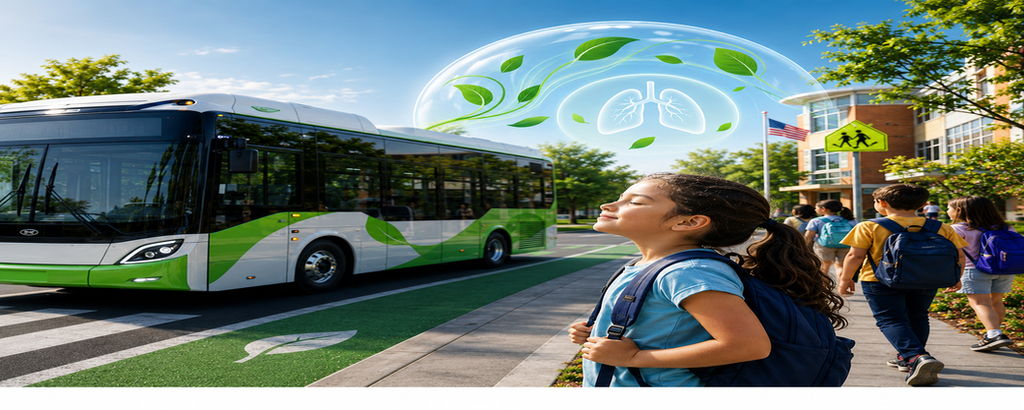
Every school day, millions of children begin and end their day on a school bus. For decades, these buses have served as one of the safest and most efficient forms of student transportation. However, while traditional diesel-powered school buses have reliably transported students, they have also exposed children to harmful air pollution. As concerns about climate change, air quality, and public health continue to grow, schools across the world are embracing zero-emission buses as a cleaner and healthier alternative.
The transition to zero-emission school buses is about much more than reducing carbon emissions. It is fundamentally about protecting children’s health, improving the learning environment, creating safer communities, and investing in a healthier future. Students are among the most vulnerable populations when it comes to air pollution because their lungs are still developing, they breathe more rapidly than adults, and they spend significant time commuting to and from school.
Electric school buses eliminate harmful tailpipe emissions, significantly reducing students’ exposure to pollutants such as nitrogen oxides (NOx), particulate matter (PM2.5), and carbon monoxide. These improvements in air quality can lead to measurable health benefits, including fewer asthma attacks, improved lung function, better attendance, and enhanced academic performance.
This article explores the direct relationship between zero-emission buses and student health, examining the science behind air pollution, the health risks associated with diesel buses, and the many ways electric school buses contribute to healthier students and stronger communities.
Understanding Air Pollution from Traditional School Buses
For decades, diesel engines have powered school transportation because they offer durability and fuel efficiency. Unfortunately, diesel engines also produce a variety of harmful pollutants.
Common pollutants emitted by diesel buses include:
- Fine particulate matter (PM2.5)
- Nitrogen oxides (NOx)
- Sulfur dioxide (SO₂)
- Carbon monoxide (CO)
- Volatile organic compounds (VOCs)
- Black carbon
- Greenhouse gases such as carbon dioxide (CO₂)
These pollutants are released directly into the air surrounding schools, neighborhoods, and bus loading areas. Students waiting at bus stops or riding inside diesel buses often experience higher exposure levels than adults because of their proximity to the exhaust.
Studies have shown that pollution levels inside diesel buses can sometimes be significantly higher than outside air due to exhaust entering through windows, doors, and ventilation systems.
Why Children Are More Vulnerable to Air Pollution
Children are not simply smaller adults. Their bodies are still growing, making them especially sensitive to environmental pollutants.
Several factors increase their vulnerability:
Developing Lungs
Children’s lungs continue developing throughout adolescence. Exposure to pollutants during this period can permanently reduce lung capacity.
Faster Breathing Rates
Children breathe more air per pound of body weight than adults, increasing their exposure to airborne contaminants.
Weaker Immune Systems
Their immune systems are still maturing, making it harder to defend against pollutants and respiratory illnesses.

Health Risks Associated with Diesel School Buses
Increased Asthma Attacks
Asthma affects millions of children worldwide. Diesel exhaust is one of the leading environmental triggers.
Exposure can cause:
- Wheezing
- Persistent coughing
- Chest tightness
- Difficulty breathing
- Emergency room visits
Children with asthma often experience worsening symptoms after riding diesel buses regularly.
Respiratory Infections
Air pollution weakens respiratory defenses, increasing susceptibility to:
- Bronchitis
- Pneumonia
- Viral infections
- Chronic coughs
Cleaner air significantly lowers these risks.
Reduced Lung Function
Repeated exposure to diesel exhaust may reduce lung growth in children, affecting breathing capacity into adulthood.
Reduced lung function can impact:
- Physical activity
- Athletic performance
- Overall health
Cardiovascular Effects
Although heart disease is commonly associated with adults, research indicates that air pollution also affects children’s cardiovascular systems.
Pollutants may contribute to:
- Inflammation
- Elevated blood pressure
- Changes in blood vessel function
Cardiovascular Effects
Although heart disease is commonly associated with adults, research indicates that air pollution also affects children’s cardiovascular systems.
Pollutants may contribute to:
- Inflammation
- Elevated blood pressure
- Changes in blood vessel function

Health Benefits Inside the Bus
One overlooked advantage is cleaner air inside the vehicle.
Without diesel exhaust entering the cabin, students experience:
- Less exposure to harmful particles
- Reduced odors
- Improved ventilation
- More comfortable rides
This is particularly important for children who spend long periods commuting.
Better Learning Outcomes
Healthy students learn more effectively.
Cleaner air contributes to:
- Improved concentration
- Reduced fatigue
- Better memory
- Increased classroom participation
Teachers also benefit from healthier working conditions.
Supporting Mental Well-Being
Environmental quality influences mental health.
Cleaner neighborhoods with lower pollution levels can contribute to:
- Reduced stress
- Improved mood
- Greater sense of safety
- Better community satisfaction
Best Practices for Schools Transitioning to Zero-Emission Buses
Schools considering electric buses should:
- Evaluate existing transportation routes.
- Plan charging infrastructure early.
- Train drivers and maintenance staff.
- Work closely with utility companies.
- Seek government grants and incentives.
- Educate parents and community members.
- Monitor air quality improvements.
- Measure student health outcomes over time.
Building a Healthier Future
The shift to zero-emission buses represents an investment in children’s futures.
Every electric bus introduced into a school fleet contributes to:
- Cleaner air
- Healthier lungs
- Better learning environments
- Reduced healthcare costs
- Stronger communities
Conclusion
The connection between zero-emission school buses and student health is clear and increasingly supported by scientific research. By eliminating harmful diesel exhaust, electric buses provide cleaner air for students, reduce asthma triggers, improve respiratory health, create quieter learning environments, and contribute to stronger academic performance. Beyond the school grounds, they also support healthier neighborhoods, lower greenhouse gas emissions, and advance environmental equity.
While transitioning an entire fleet requires planning and investment, the long-term rewards extend far beyond transportation. Every zero-emission bus represents cleaner mornings at bus stops, healthier classrooms, safer communities, and a meaningful commitment to children’s well-being. As more school districts embrace sustainable transportation, they are not only modernizing their fleets but also giving future generations the opportunity to breathe easier, learn better, and thrive in a healthier environment.